
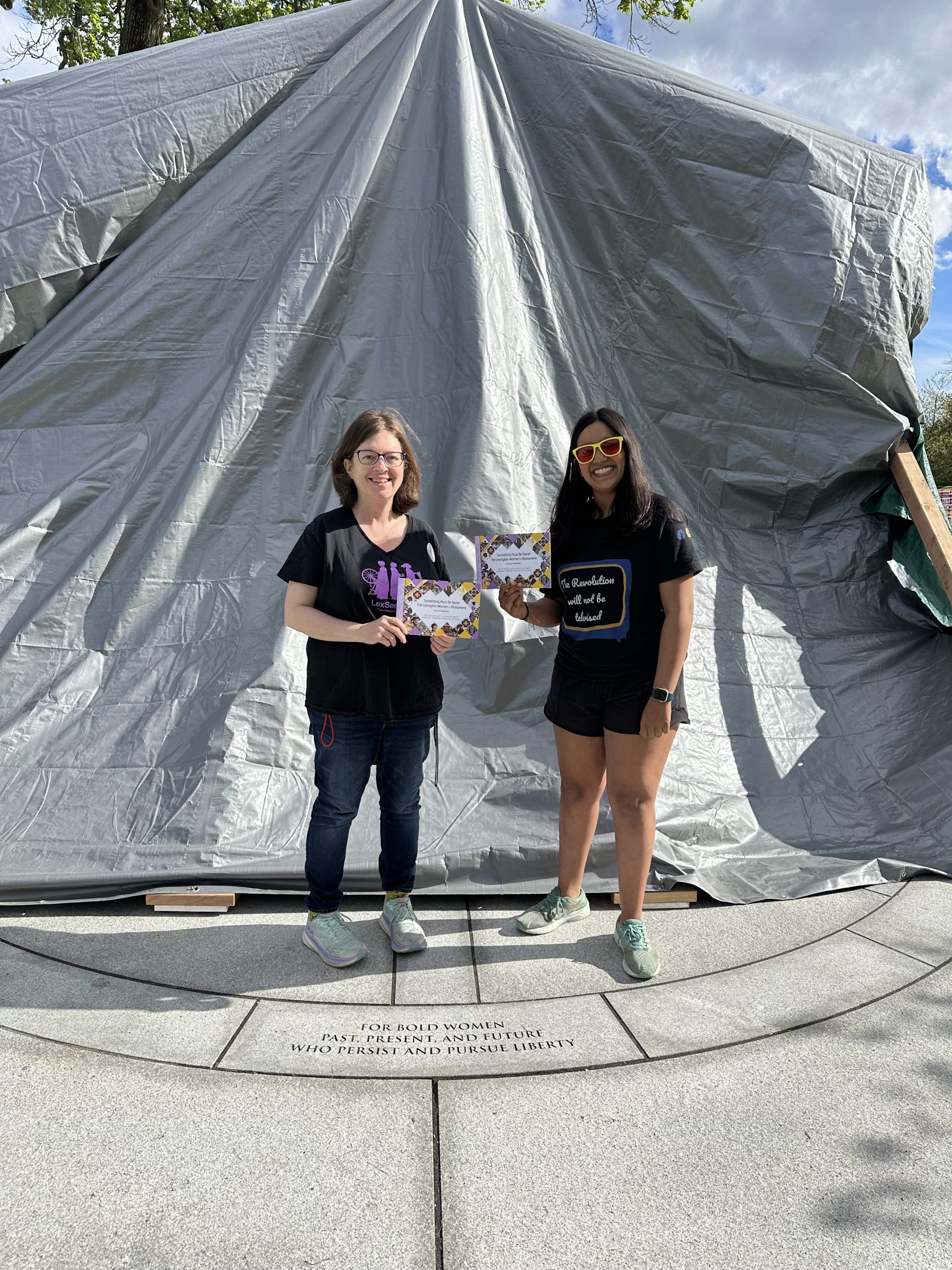
An interview with Jessie Steigerwald, President of LexSeeHer, on the “Something Must Be Done!” monument
Hi history nerds, or shall I say herstory nerds? This is a special post because we talked to Jessie at LexSeeHer to find out more about the new monument in Lexington center. You can find it in front of the Visitors Center, or next to Buckman Tavern (1 Bedford Rd). The unveiling is this Wednesday, May 15th, at 10:30am, and more activities come at 2pm on Saturday the 18th. We will be at both events and can’t wait to see you! This project has been in motion for quite sometime, and we are very excited to see the finished product. Let’s hear a bit more about LexSeeHer and the “Something Must Be Done, Something Is Being Done” monument!
How and why did you get involved with LexSeeHer?
So, with friends, I started LexSeeHer with the idea to make women visible in our community.And by that, what I meant is if you walk through this historic district (Battle Green), because there’s multiple ones in town, if you walk through this historic district, you see a lot of spaces in the built environment where we learn our history, and all of it relates to contributions made by men. And not just men from the battle, or from the 1700s, but also the following centuries.And it just felt like it was time to make it more clear that women have been here all along contributing.
Cool! It seems that you have a passion for history. Do you remember the first time you were here? thing like that made you fall in love with the subject?
Well, yes, In some ways. My mom was a teacher and during the bicentennial and I lived in New York. So for us, the bicentennial was 1976. I’ve learned here [in Lexington], of course, the bicentennial is 1775. So in the Bicentennial in New York in 1976, my grandmother and my mom made me a period outfit to wear.
And I still remember going to the colonial house. The local news station was filming something and my job was to go eat a colonial cinnamon cookie. I guess it really made an impression on me to put on that outfit and imagine being in the past. I’ve always been really interested in that period of history and then like every other period. So in college, I studied both art and history, not art history, but like the way we construct everything around us. All the choices that are made, and in my department that was called the built environment.
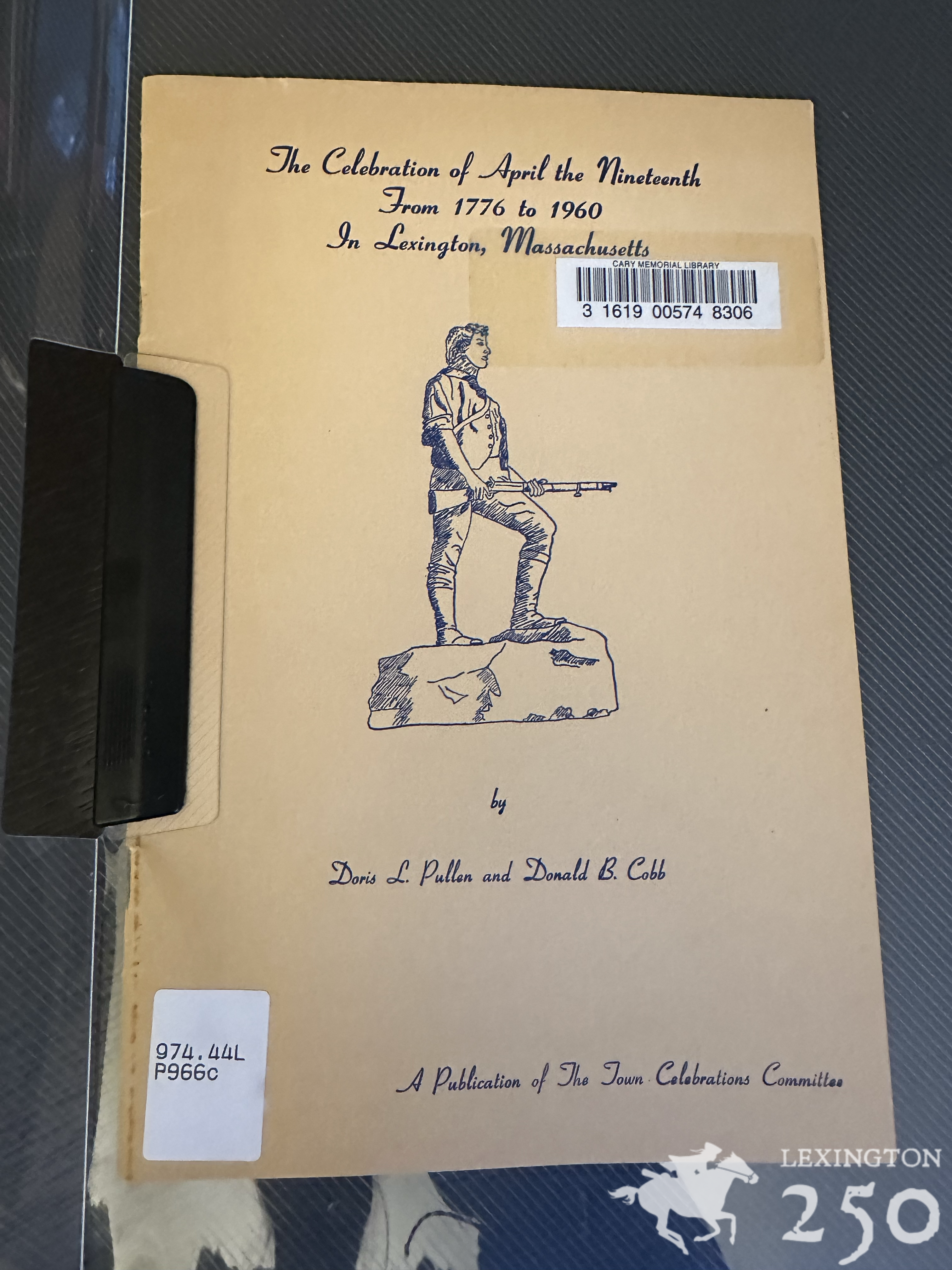
This is a book that was made a just a bit before the bicentennial! They have many souvenirs and relics at the Cary Memorial Library, which is across the street from the monument.
So, is there a specific part/aspect of like history that you love, or it’s just that in general?
I’m especially interested in women and families and relationships, so men also, but in relationship with other people. I think part of why I was so excited about history was it was all these stories about interesting people and their friendships, their relationships, or how they overcame obstacles.
I really still, love that the best. There’s always the other side, I love material objects. I love sewing, I like making things. It’s been really exciting to have the history of our community, meet this amazing sculptor, and then see how you can tell the story in this really cool way.
What is the significance of this monument? I understand that this is the first monument dedicating to women in Lexington. Is there like, what’s the story behind that?
So the monument includes, it focuses on women’s contributions and we spent a lot of time as a team thinking about how we would present to the town that we wanted permission to put a new monument in this town.
So being connected to history was kind of easy because everyone is connected to history in some way. But how do you demonstrate and pick who the women are going to be? And as one of the women said on the Monuments and Memorials Committee, “you have to, we have to explain why these women were worthy of remembering.”
That was really interesting intellectually because almost all of the other markers are for men who were in the military. But women were not allowed to serve in the military for hundreds of years. But what was interesting is thinking about all the other contributions that are made that are not military, which is many like scientists, educators, parents, farmers, musicians, aviators, lawyers, like there’s authors, there’s so many ways people contribute.
And I think part of the significance was showing this kind of Community’s history was influenced by all of his kinds of contributions, uh, at every point in time. And then the other part was really showing that women are important, women are worthy of recognition, and were excluded from a lot of jobs.
We couldn’t be in the clergy either. There’s a monument over there [on the Battle Green], but it’s also on men because women weren’t allowed to be in the clergy. So we’ve had to find, actually ways to limit how many women could be in there. Even there’s more than 20 women and girls.
Is there anyone in the, in the sculpture who like specifically inspires you?
I’m truly inspired by all of these women. So I love the historical research and I’ve researched all of the women. And then we have a whole research team of people who focus on one person or another. But in writing the book, I spent time refreshing my memory on four years of learning about these women.
They all overcame obstacles. They all lived at times that for them probably they felt like, “Wow, this is a really hard time in American history” for all of them. And yet they all kept taking it. When they saw something was wrong, none of them were bystanders. They were all actively engaged in the questions of their times.
We just went through a pandemic. So it was really helpful to sit there and think, “Wow, look what she did. Look what she did. Look what you did.” It gives me a lot of hope.
And do all these women have connections to Lexington or connections to Massachusetts as a whole or the revolution or they’re all connected to Lexington?
That was our rule. Everyone had to be connected. We had five months of open community nominations. So there were people nominated that none of the 15 of us had heard of. We just didn’t know that person. It’s a big community now with like 32,000 plus people. So you could nominate, anybody could nominate.
They had to tell us a little bit about them, and then we independently went to go research the person because it felt like you can nominate a relative who you love very much, but we need to have sort of an objective sense of, “What was this person about? What were their contributions?” One thing that came up for us, was a person who ended up opposing the monument who had said, “That one woman, she doesn’t have anything to do with Lexington.”
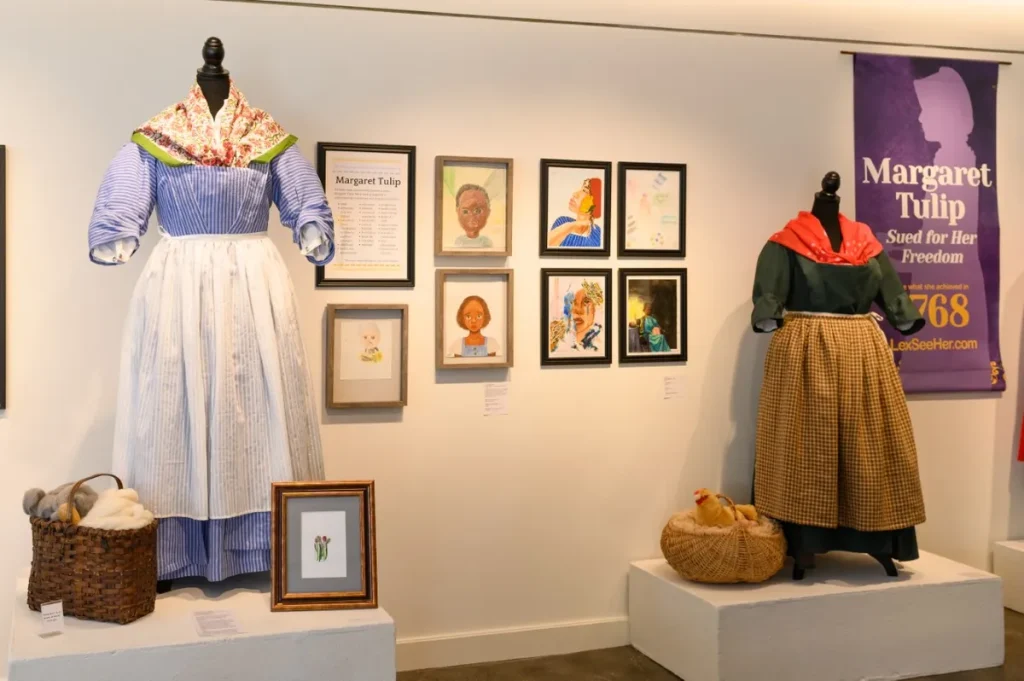
And by that she meant she wasn’t born in Lexington. But that woman who was named Margaret Tulip who lived here for 70 years. She was enslaved and she was brought here, and had no say in the matter. So for us, it didn’t matter that you were born here. It matters what your contributions were [and that they were in Lexington].
Now there’s a teacher [Janet Haas, Lexington’s former orchestra director] in the monument who never lived here, but taught music for 31 years. And for us, again, she belongs to Lexington. That is a Lexington woman. And she impacted obviously thousands of string players in her career here and other students who were impressed by her.
Me, Sabrina Bhattacharjya: We still, we still use her music today. Like I do orchestra, I play viola and like all the stuff that’s like, she essentially writes these grand pieces that everyone can play. And I feel like there’s something that’s very like Lexington about that. Like everyone can do something. Everyone can make a contribution, which I think LexSeeHer is also part of.
Jessie Steigerwald:
She’s exactly that! And that’s why when you see her in the monument, she’s taking the piece ode to joy, and she’s making that work in different parts. That’s what I was thinking about and that’s why we picked it because she used to do these concerts where she’d have the fourth grade students begin and then the middle school and high school all play together. And I can tell you, I had a kids in the string program that, you know your parent, you hear a kid screechy at the beginning and then you hear them at the end, and it’s so beautiful.
She really showed adults as well as kids that progression. Ugh. Yeah. But all the women like that, they all really made these lasting contributions. We just don’t always know that they happened because the stories have not been celebrated. But now they will.
Is there any specific way in which you found a story which you wouldn’t have unless you were in this project?
Definitely, because some of the women who were nominated, I just, I’d never heard of them. I didn’t know about them, they all had surprises. Like, I’ll give you an example. There’s a woman whose name is Ruth Morey, and she was the first woman elected to the Select Board in 1956. Many people, nominated her and thought she was really important.
That sounded very worthy in itself. It must have been really hard to become that person. But the more I researched her, I was surprised by so many things because she didn’t just contribute to the government. She was also the first woman president in the historical society. So it’s like, “oh, she was doing, you know, local government and also doing this”, but it turns out she did like 19 things really well.
And then she was interviewed about what her occupation was and she wrote no occupation. Like in her time, all that volunteer work didn’t equal that she was “something”, which is fascinating to me. You know, it’s really very interesting. But every time I learn something new about her, I’m like, “boy, Ruth Morey does not disappoint.”
Because to be someone who overcame that hurdle of the first woman entrusted with the highest local office, she clearly impressed an enormous number of people with her non-occupational. Like she must have been extremely organized, really good with money, made sound decisions, and she was probably a really good listener.
So two women who kind of contrast, Phebe Bannister Burdoo came to Lexington through Concord, we don’t know a lot about her. A woman named Alexandra Moellmann really focused on researching her life. So Alexandra researched her life, and she is one of the people we, she’s in the monument because it thinks about this idea of being a revolutionary mother and like that it is a contribution to have a child is a contribution.
It is her son ends up being in the battle and serving the Revolutionary War. She doesn’t want to see it though she dies just a couple years after he’s born, black maternal health is still an issue. White women also died at the time, but she died about a little over two years after he was born. We don’t know, but been pregnant with another child, we don’t know. That’s about the spacing who lived around some had seven or ten kids.
But it was a contribution. So it feels like the motherhood should count for a short amount of time. On the flip side, Caroline Wellington never had children. Lived here, she died in her 90s. Huge contributor, not a mother, what made her contributor and an important woman is not and should not be defined by the fact that she did or didn’t have kids. So Meredith’s design is so cool because she, like, there’s enough spaces that we can think about women and girls, and we don’t have to stereotype.
What influence do you think this monument will have on everyone, specifically young girls?
What I really hope, and I know everyone on our team hopes, is that children of all genders who see this will look up and they will see that because it exists. What’s being shown is important. The fact that it’s a monument, the fact that it’s a large scale work of beautiful public art with a lot of detail. Just by seeing it, it sends a message that women and girls matter that, we’re important. That’s a very simple hope. But I think being invisible for so long, a lot of people don’t expect to see women, so they don’t see that it’s missing.
They’re just facts. Like, I think those are just, they’re not opinions. They’re just, they’re facts. Like it was the idea that the father was the head of the household and that once you were married, you no longer had a separate legal identity. You couldn’t own property anymore. So like Ruth Buckman’s house, she, it was her grandfather. She would have played there as a kid. So she’s married. So then when it’s being inherited, it’s not hers, it’s his, or even Margaret Tulip’s owner/enslaver is the man, not the woman who she grew up in the house with.

Buckman Tavern, the house Jessie is referring to when talking about Ruth Buckman.
So it’s just, it’s just so embedded and it’s everywhere around us and within us. But you know, for us, one of the things that struck me was when I read the statistic about 7% of monuments in America include historic women and even fewer women of color, it’s like, Oh, that makes sense because yeah, Statue of Liberty. Okay. Let me keep thinking. Like, it’s just like, she’s not a lot of monuments that include women. And I think for our group, it feels like Lexington was predominantly white and black for most of the centuries, but now like 30% to 40% of our school districts and adult population are women who are Asian or Asian American as they identify.
And when Meredith showed us her design and at the center, one of the figures was a young Asian woman. We’re like, yes, this is great because when you come up, it’s just another way to feel like you can identify with this person because they’re a lawyer. You can identify with this one based on their race. You could identify with this person based on their marital status. You could identify, like, there’s just, there’s a lot of ways to It’s not everybody. And what she said to us was so wise. She said, you’re going to wish there were more women. Still, you’re still going to wish there were more women. And that’s true.
Someone said, I wish you had a nurse. Very disappointed. I’m like, I’m so sorry. Like, you know, there’s a lot of people in there, but there could be more. But hopefully there will be more monuments in the future that will also include women.
How do people learn about these figures? Like, let’s say a year from now, like when people are trying to learn about who is on the monument, how can they do that?
What we’re hoping is, number one, the website. will always be there (LexSeeHer.com). Number two, we have a book now, called “Something Must Be Done: The Lexington Women’s Monument”, and it’s a starter because all the women need their own book. But this little bit about each of the women, we have a research team that continues.
We have a herstory program. So people are volunteering to portray the women. So my friend Sue portrays Peggy Kimball, the aviator. She went in the Patriot’s Day Parade to be seen. And it means that we can have events or school visits where people can learn about these different women. And I think hopefully teachers will hear, you’re learning about a woman, but these women are situated in history. So if you’re learning about Ada Govan and the Bird Sanctuary over by Fiske Elementary School, you’re also learning about the Great Depression and the economic realities on the home front.
Like we’re doing this in a way that’s about biography, but also about the broader strokes of history. So there’s programming, books, guide, people can take their own self guided tour called
“In Her Shoes” and kind of explore basically all the unseen women’s contributions, that they’re here.
When you go and see the normal school right now, it doesn’t mention that normal school was an all women’s school. And like, just knowing that changes maybe how you look at the building. Like, First Teachers College, oh, it was all women in there. Our signs don’t really necessarily tell us the whole story.
There’s a shovel in the monument with Ruth Morey. And partially because Meredith had, each person has like an object, kind of a classical sculpture thing. And we were talking about Ruth Morey and thinking about it. And I didn’t know as much about her at the time, but I knew something. She was in office at a time when there’s a lot of buildings. She actually worked on the visitor center project. She worked on the Hancock Clark house too. But I was like, you know, a shovel would be good because we have these groundbreaking ceremonies and people have shovels.
I just made contact with their family and they sent a newspaper clipping of her at Emery park holding a shovel. I was like, it’s just, it’s sort of like the 4:19 thing on your clock (we had a time check and I said it was 4:19, like April 19th, 1775). There’s these things that have happened. You’re like, it’s so aligned.
What is your favorite thing that LexSeeHer has done before this monument? What are you most proud of?
Probably I’m most proud of the research team put together an installation at LexArt with their partnership called, “Put Her On The Map”, and it was focused on black women and black women who are in the monument. I’m really proud of that because I feel like we got to focus on three women and it’s challenging like even in this interview, like I can tell you the great stories about all 20 women, but if we pick three women and we tell you about them, it makes them not like little pencil figures but like people, like whole people. We get to look at what kind of clothing do people wear in different centuries and then we took a portion of that show to Hastings Elementary School and I was very proud to be with Celeste Freeman, who’s one of our vice presidents telling kids because kids should know from the start that women and girls have been part of the story.
So that made me really proud. I was also really proud of the spinning tableau, and we’ve grown. So now there’s 45 women dressed up and it reminds you in 1769 when Anna Harrington said, “Come to my house, bring your spinning wheel, let’s protest.”
The women at the time, even when they had these structural barriers, they were still thinking intelligent people who did what they could strategically, who moved things forward in the direction of the way things ought to go, whether you agree with them or not, they weren’t vacuous or empty they were people. They would be the ones to tell the story. But I’m really proud because when you get 45 women together, it says, oh yeah, people totally noticed that. There were only a thousand people in the whole town, it’s like half the high school. You would notice if 45 people in the high school stood outside with their spinning wheels.So I guess making, making it visible, getting the stories out there in a, in a way that lets other people connect.
We’ll end this post with a revolutionary quote from a Lexington woman
We must not forget that some of the best ideas seemed like nonsense at first. The truth will prevail in the end. Nonsense will fall of its own weight by a sort of intellectual law of gravitation. If we bat it about, we shall only keep an error in the air a little longer. And an ew truth will go into orbit.”
Cecilia Payne-Gaposchkin
Can’t wait to see you at the events on Wednesday and Saturday!

Sabrina Bhattacharjya